Volume I
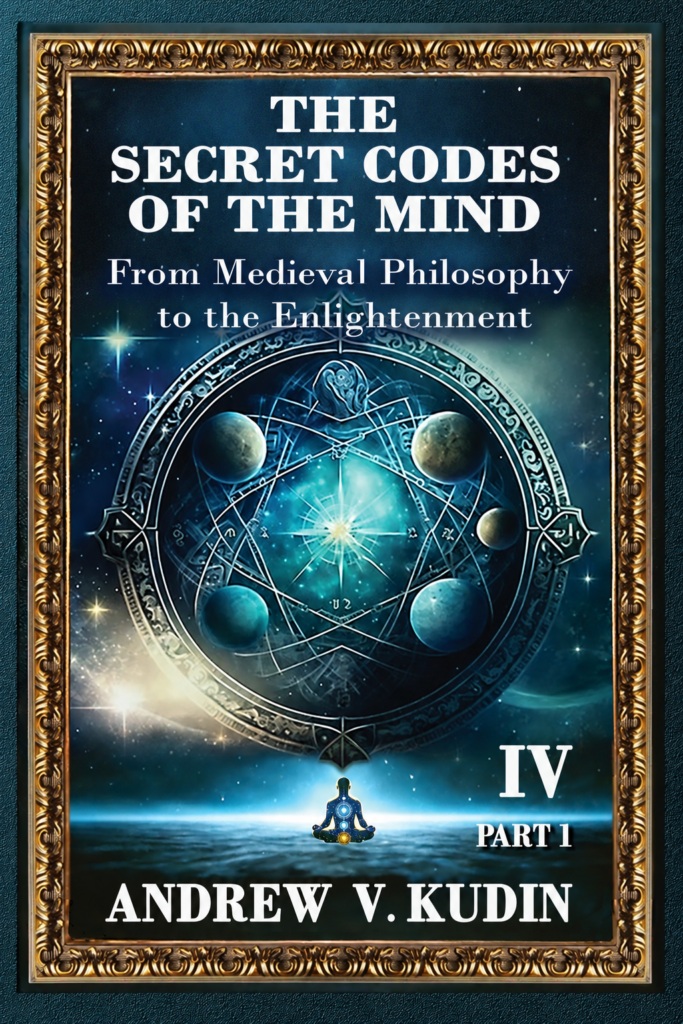
Book · Volume IV · Part I
The Secret Codes of the Mind: From Medieval Philosophy to the Enlightenment, Part One
Second Revised and Expanded Edition
- Hardback
- ISBN 978-1-971325-31-6
- Paperback
- ISBN 978-1-971325-32-3
- Kindle
- ISBN 978-1-971325-33-0
- EPUB
- ISBN 978-1-971325-34-7
- LCCN
- 2026914137
Overview
About the Book
What happens when reason enters the domain of faith—and refuses to fall silent?
For nearly a thousand years, the most rigorous minds in Christian, Islamic, and Jewish thought pressed a single question to its limit: how far can human reason go on its own—and where must it yield to revelation? From Medieval Philosophy to the Enlightenment, Volume IV, Part One follows that argument through four major currents of medieval thought.
Lecture 19. Early Christian Philosophy: Augustine and His Teachings.
Augustine turns philosophy inward. Memory, intention, conscience, freedom, evil, the divided will—each becomes a problem of knowledge and moral responsibility. How can human beings choose freely, know the good, and remain accountable in a universe governed by divine providence?
Lecture 20. Thomas Aquinas and Scholasticism: The Synthesis of Reason and Faith.
Aquinas gives medieval thought a disciplined architecture of argument. The disputed question—objections, principles, distinctions, replies—becomes a method for testing claims. Metaphysics, causality, natural law, and theology converge on a decisive problem: what can reason demonstrate, and what belongs to revelation alone?
Lecture 21. Philosophical and Mystical Traditions in Islam.
The disputes of the Muʿtazila and the Ashʿarīs unfold alongside the translation movement, falsafa, and the work of al-Kindī. Questions of divine attributes, the created Qurʾan, human action, prophecy, causality, and rational demonstration keep the argument over the reach of reason alive, while mystical traditions open another path to knowledge, one that rational demonstration alone cannot exhaust.
Lecture 22. Jewish Philosophy and Kabbalah.
Maimonides, Naḥmanides, the Bahir, the Zohar, and the kabbalists of Safed confront creation, divine unity, law, interpretation, exile, commandment, and human responsibility. Kabbalistic ideas of contraction, broken vessels, and intention draw metaphysical questions into a vision of cosmic fracture—and of human participation in its repair.
Can revelation withstand rational scrutiny? Is human freedom compatible with divine providence? Can moral truth be known by reason alone? What happens when philosophical proof, sacred law, and mystical knowledge approach the same ultimate questions by different routes?
Built for active study
- Discussion, analytical, and comparative questions for classroom debate
- Essay and research assignments for independent inquiry
- Suggested readings: primary sources and essential scholarship
Who this book is for
- The instructor teaching medieval philosophy, philosophy of religion, Western philosophy, or the history of philosophy—and looking for a medieval philosophy textbook students will argue with rather than skim.
- The student who wants the arguments themselves, not a summary of them.
- The independent reader seeking a serious, unhurried guide to one of the most intellectually charged periods in the history of thought.
About this edition
SECOND REVISED AND EXPANDED EDITION. Volume IV of The Secret Codes of the Mind is published in three separate parts—medieval philosophy, the modern era, and the Enlightenment—which together form a single conceptual volume. Part One contains Module V: Medieval Philosophy.

Sample
Read an Excerpt
Call medieval philosophy “the handmaiden of theology,” and you have already misunderstood the period. Reason did not simply serve revelation—it fought for room to work within it. Christian, Islamic, and Jewish thinkers took up faith, being, and knowledge as questions revelation could not settle on its own, and they answered to a discipline theology never imposed: logic, conceptual precision, and argument that had to earn its own conclusions.
Related Volumes
In This Series
Volume II
The Secret Codes of the Mind: Ancient Greek Philosophy
Volume III
The Secret Codes of the Mind: Eastern Philosophy
Volume IV · Part I
The Secret Codes of the Mind: From Medieval Philosophy to the Enlightenment, Part One
Volume IV · Part II
The Secret Codes of the Mind: From Medieval Philosophy to the Enlightenment, Part Two
Volume IV · Part III
The Secret Codes of the Mind: From Medieval Philosophy to the Enlightenment, Part Three
Purchase