Contents
Introduction — When the Obvious Becomes a Question
What Is Philosophy? Definition and Meaning
How Is Philosophy Different from Science and Religion?
What Are the Fundamental Questions of Philosophy?
What Are the Main Branches of Philosophy?
How Does Philosophy Help Us Understand Reality?
Why Is Philosophy Important in Everyday Life?
Conclusion — Philosophy and the Examined Life
Introduction — When the Obvious Becomes a Question
Philosophy is the disciplined inquiry into what exists, what we can know, and how we ought to live. It reaches beneath our judgments to the concepts and reasons on which they depend. A conviction can govern an entire life without ever having faced a single honest question.
Consider an ordinary sentence: “I know this is true.” We say it with ease, although the distance between believing and knowing is often immense. Evidence supports a claim; certainty can flourish where evidence is absent. The philosophical problem begins when we ask what justifies our confidence and what kind of truth our words are meant to express.
Such inquiry reaches far beyond the classroom. A judge has to separate evidence from suspicion. Someone choosing a course of life weighs whether a long-held ambition is worth its price. Even the conviction that we are free to make these decisions rests on assumptions about the mind and the world in which it acts.
After more than four decades of teaching philosophy, I have learned how quickly a familiar word can lose its apparent simplicity when a student asks for its grounds. That moment deserves attention: it separates an opinion one holds from an opinion one can justify.
What Is Philosophy? Definition and Meaning
The Greek word philosophia joins philein, to love, with sophia, wisdom. Its history preserves an important distinction between the possession of knowledge and the desire to understand. Diogenes Laertius reports that Pythagoras called himself a philosopher, or lover of wisdom, and declined the title of sage (I.12). The story reaches us through a much later author and should be read as a tradition about how philosophy understood itself; whether Pythagoras actually said it cannot be documented.
Plato carries the difficulty further. In the Symposium, Diotima places the lover of wisdom between those who already possess it and those whose ignorance leaves them satisfied with themselves (204a–b). Philosophical inquiry requires enough knowledge to recognize a problem, together with enough intellectual independence to discover that one’s understanding remains incomplete. The wish to learn is powerless when certainty has become a habit.
A discipline born of that restlessness ranges widely. It considers whether the world is as it appears, when reasoning is valid, what authority moral claims possess, and on what principles institutions govern human lives. These are connected tasks. A claim about what human beings are influences what duties we assign to them; an account of knowledge determines what counts as a defensible claim about either.
The Greek origin of the word should never obscure the wider history of philosophical thought. Nāgārjuna, the second-century Buddhist philosopher of India, argued that nothing possesses an independent essence, since everything arises in dependence on something else. Confucius regarded the cultivation of character as inseparable from the proper ordering of human relations. Ibn Rushd, writing in twelfth-century al-Andalus, asked how far reason may go when it interprets revealed scripture. These questions arose in different languages and institutions, and every one of them belongs to humanity’s long effort to understand itself.
Philosophy is recognizable across these differences through what it asks of thought: concepts must be clarified, assertions defended, and implications faced. Its traditions disagree about where such scrutiny leads, and the disagreement is one of the reasons their work remains worth reading.
How Is Philosophy Different from Science and Religion?
For most of its history, philosophy included what we now call science. Isaac Newton titled his great work of 1687 Mathematical Principles of Natural Philosophy, and physics was taught as natural philosophy long after his death. Scientific investigation now has methods of its own: observation, measurement, and experiment, organized to develop and test explanations. Philosophy examines the concepts on which such work relies, among them evidence, causation, and explanation, and takes up questions of value that no experimental result can settle. A laboratory can establish what a drug does to the body; whether a patient may be given it without consent is a question of another kind.
Religious traditions make claims about revelation, ultimate reality, and obligation. Philosophy examines the meaning of those claims and the arguments offered for them, and it has often grown within the traditions themselves. Thomas Aquinas held that a truth of reason and a truth of faith can never contradict each other, since both come from the same divine source. In Fear and Trembling, Kierkegaard’s pseudonymous narrator, Johannes de silentio, confronts Abraham’s willingness to sacrifice Isaac and the troubling possibility that faith places a person beyond the ordinary demands of ethical judgment. Between these positions runs one of the longest disputes in Western thought, and it remains open.
What Are the Fundamental Questions of Philosophy?
The deepest philosophical disputes begin with problems that remain standing after every fact has been gathered. A complete inventory of the objects around us would still leave the meaning of existence unexplained. Knowledge of the brain’s activity, however detailed, still has to explain why that activity is accompanied by experience at all.
The relation between mind and world stands at the center of this difficulty. Materialist accounts seek to understand thought within a reality that exists independently of it. Idealist traditions assign a more fundamental role to mind, ideas, or the conditions of experience. Descartes treated thinking as the starting point of his search for certainty; Kant investigated the contribution of human understanding to the world as we experience it. The competing accounts concern the nature of reality and the terms on which we can claim to know it.
Knowledge raises difficulties of its own. Our access to things is mediated by perception, memory, language, and inference. We correct perceptual errors by comparing experiences, yet every correction still depends on some means of deciding what counts as evidence. The philosopher asks where justification begins, how far it reaches, and what makes an explanation preferable to its rivals. The sciences themselves rely on reasoning from what has been observed to what has yet to occur, and the justification of that step is still disputed.
Freedom brings the problem closest to home. Human decisions emerge within conditions that precede us: bodies, histories, relationships, and social institutions. Some accounts of moral responsibility insist that a person could have chosen otherwise. Others argue that responsibility depends on the relation between action, deliberation, and the agent’s reasons, even in a causally ordered world. Behind the disagreement stands a pressing human question: on what grounds do we praise, blame, punish, or forgive?
These inquiries cannot be completed independently. The account we give of consciousness affects our conception of freedom; the standards we adopt for knowledge govern which claims about freedom we can defend. Philosophy returns to such problems because our answers shape the kind of world we believe ourselves to inhabit.
What Are the Main Branches of Philosophy?
Philosophers have developed distinct disciplines to pursue questions that require different kinds of reasoning. Their boundaries are useful, although an inquiry rarely remains within them for long. The problem of responsibility, for example, passes from an account of human agency into ethics and the justification of law.
Metaphysics concerns existence and the structure of reality. Aristotle’s inquiries into substance and causation are early expressions of questions that still occupy metaphysicians. Whether time has an existence independent of events, or whether the mind can be understood entirely in physical terms, belongs to the same field.
Claims about reality require a theory of how they can be known. Epistemology studies evidence, justification, and the limits of human understanding. Its oldest dispute sets reason against experience: rationalists trust what the mind can establish by its own light, while empiricists such as Locke locate the origins of our ideas in experience, through sensation and reflection. Each side imposes a different burden on anyone who claims certainty.
Logic investigates the standards by which reasoning succeeds or fails. Premises can be plausible and a conclusion can still fail to follow from them. A valid argument has a conclusion that follows from its premises; a sound argument is valid and has true premises. The distinction guards against a common error: taking a flawless chain of reasoning for proof that its conclusion is true.
Ethics asks what makes an action right, what we owe one another, and what kind of life is worth living. A promise kept at great personal cost shows how quickly these questions turn concrete. The obligation that seemed simple when the promise was made must now be weighed against loss, and the principles by which we judge fidelity and duty are put on trial. In literature these trials acquire a human depth that abstract argument alone cannot reach. Dostoevsky lets Raskolnikov act on the theory that an extraordinary man may step over the moral law, then follows him past the murder into a conscience that refuses the theory’s verdict.
Aesthetics examines artistic value and the experience of the beautiful and the sublime. It asks why a painting can unsettle its viewer and why a piece of music can stay with us long after its final note.
Political philosophy turns toward authority and collective life. It studies the grounds of legitimate government, the requirements of justice, and the rights that political institutions ought to protect. A law can be validly enacted and still stand in need of moral justification. That tension connects political philosophy with ethics and the philosophy of law.
The map extends further. The philosophy of mind and the philosophy of language study consciousness, meaning, and reference; the philosophy of science examines how evidence supports an explanation. The philosophy of religion weighs arguments about the divine, and legal philosophy asks why a law binds anyone at all. Each of these fields begins with a narrow question and soon finds it crossing into the others.
How Does Philosophy Work?
A philosophical problem often begins with a word whose meaning seemed settled. Take personal identity. A woman of sixty remembers the child she was at six, although her body, character, and circumstances have changed. What warrants our conviction that she remains the same person? Bodily continuity answers part of the question, yet it leaves open the significance of memory and consciousness.
John Locke cast the difficulty in a memorable image in An Essay Concerning Human Understanding (II.xxvii.15). Imagine the soul of a prince, carrying with it the consciousness of his past life, entering the body of a cobbler as soon as the cobbler’s own soul has deserted it. Everyone who met him would see the cobbler. Locke insists that the person is the prince, accountable for the prince’s actions, even while inhabiting the cobbler’s body. The example separates two things that ordinary language runs together, which Locke calls the same man and the same person.
Conceptual analysis works through such distinctions. We test a definition against difficult cases, trace what follows from accepting it, and discover where the language of ordinary life has concealed a dispute. Argument then places those discoveries before criticism. A conclusion is only as strong as the reasons behind it and the inference that connects them.
Other methods disclose aspects of a problem that analysis alone leaves unexplored. Hegel follows contradictions and transformations within thought; Husserl’s phenomenology describes the structures of experience with disciplined attention. Gadamer considers understanding as an interpretive encounter shaped by history, while the skeptical tradition represented by Sextus Empiricus tests our grounds for giving assent. A problem examined through all four of them seldom looks as simple again.
The discipline requires a certain honesty about how we reach conclusions. We must be prepared to expose the weakness of a cherished argument and accept a distinction that unsettles our original position. Intellectual independence begins at home, with the standards we apply to our own thinking.
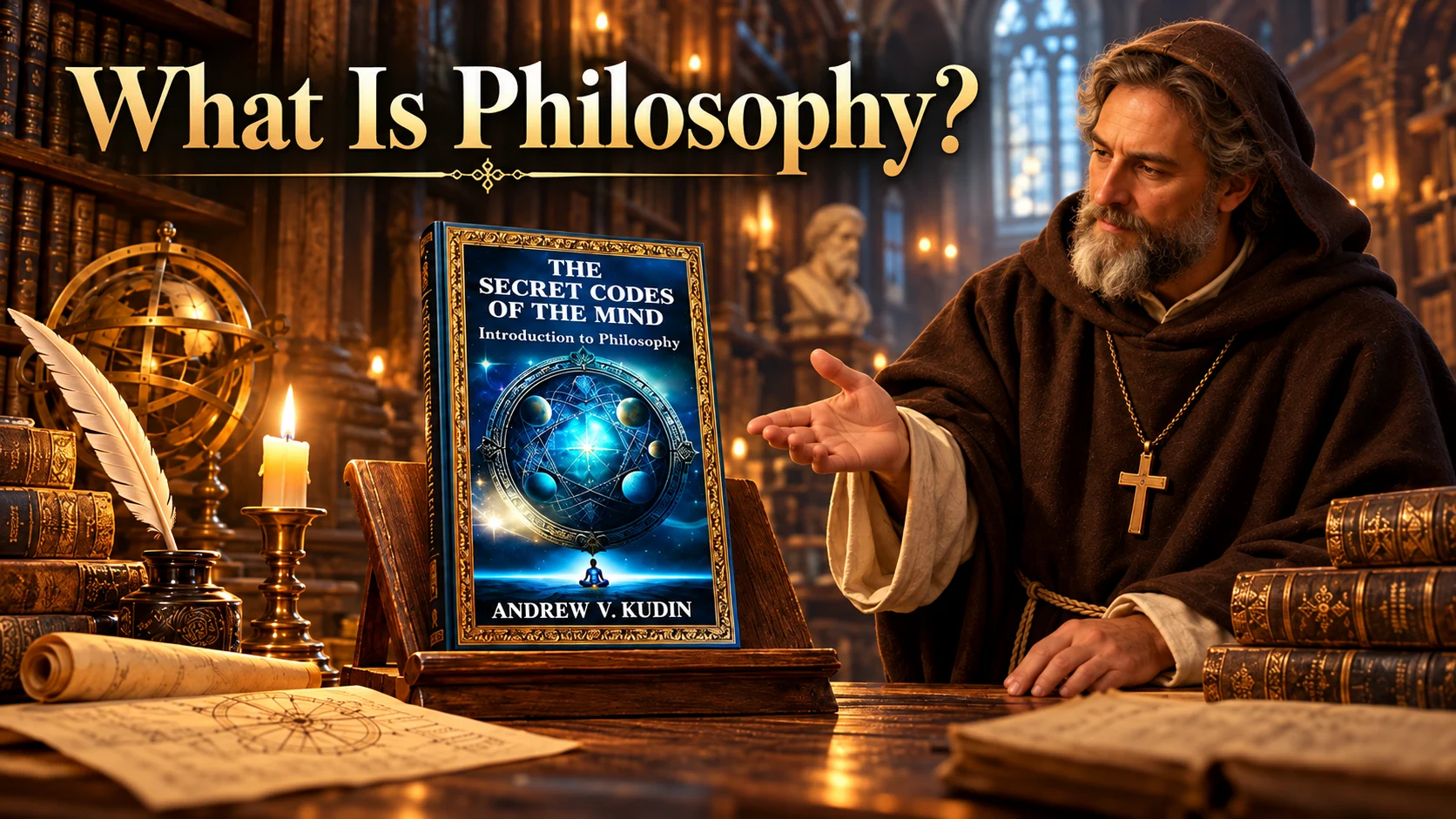
I pursue this connection between philosophical method and human judgment in The Secret Codes of the Mind, Volume I: Introduction to Philosophy. The book examines sixteen philosophical methods alongside questions of knowledge, reality, and freedom. Literature serves as its testing ground: when a character acts on a belief, the story shows what that belief does to a life, and the reader must decide whether the principle behind it can be defended.
How Does Philosophy Help Us Understand Reality?
Before we form a theory of the world, we have already described it in terms of things, changes, relations, and events. A child notices that a glass has broken; an adult asks what caused it. Hidden inside such ordinary descriptions are judgments about identity, sequence, and the connection between events.
Consider causation. A rooster may crow shortly before sunrise, yet its call does not bring the sun above the horizon. Temporal succession supplies evidence of an order of events; a causal claim requires more. Hume observed that repeated conjunction never gives us a direct impression of necessity itself. His challenge continues to matter whenever we move from a pattern we have witnessed to a claim about what must happen.
Our understanding of change encounters a similar problem. A tree is taller after ten years; a city has been rebuilt after a disaster. Calling either one the same thing through its alterations commits us to some account of continuity. Such commitments often escape attention until a dispute over property or a border drags them into the open.
Aristotle treated categories such as substance, quantity, and quality as fundamental ways in which things can be spoken of. Kant later assigned categories, including causality and necessity, a different philosophical role in explaining the conditions of possible experience. The historical distinction matters. A conceptual instrument can appear universal while concealing a controversial theory about the relation between thought and reality.
These questions reach into practical inquiry. A physician describes an injury through biological processes; a court considering the same injury examines intention, testimony, and responsibility. Both must attend to evidence, yet their conclusions answer different questions. Understanding improves when we recognize which concepts a problem calls for and what each kind of explanation leaves unresolved.
A philosophical education trains that recognition. It teaches the intellect patience: to revisit its own classifications, to ask what they assume, and to check them against what experience discloses. Under such scrutiny, what seemed to belong to the world itself sometimes proves to be a distinction drawn by the mind.
Why Is Philosophy Important in Everyday Life?
A person’s philosophy is often at work before its owner has found a name for it. The way we spend our time already expresses a view of what is worth attention, and the people we feel bound to help show what we take duty to be. Most telling of all is what we excuse in ourselves while condemning it in others.
Imagine accepting a prestigious position that requires moving far from an aging parent who depends on regular help. The salary is clear, and the professional advantages can be described in detail. The decisive question concerns the obligations that compete for the same life. No table of benefits will settle that question until the person has decided what counts as a benefit and which duties take precedence.
The problem reaches beyond private preference. Loyalty can protect friendship while shielding wrongdoing; a desire for security can lead a citizen to accept powers that threaten the freedoms security was meant to preserve. Philosophy asks us to defend the principles operating in these judgments and to consider whether we would accept them when the circumstances are reversed.
Years of teaching have made one distinction especially important to me. A student may master a definition of justice and still fail to recognize what justice requires in an actual decision. That gap is where philosophical education faces its real task. Ideas must descend into the territory of motives and temptations if they are to guide a life.
Loss, disappointment, or an unexpected responsibility can interrupt the routines through which we ordinarily make choices. The questions that follow are rarely answered by a new piece of information alone. They concern what remains worthy of trust when a familiar plan has failed. Those who have practiced asking such questions in calm years meet them with steadier minds when the calm ends.
Its practical value can be measured in the quality of our judgment: the ability to distinguish a reason from an excuse, to change an opinion when the evidence requires it, and to accept responsibility for a choice whose cost we understood. Such judgment rarely announces itself. It shows in small decisions made well, long before anyone thinks to call them philosophical.
Conclusion — Philosophy and the Examined Life
The most enduring formulation of the examined life belongs to Socrates. After an Athenian jury had found him guilty, with the prosecution demanding his death, he told the court that “the unexamined life is not worth living for men” (Apology 38a). He regarded questioning as part of the only human life he was prepared to defend, even at the cost of his own.
The challenge has not grown easier. We enter a world that has already supplied us with definitions of success, habits of obedience, and standards of approval. Some deserve our allegiance; others persist only because we have grown accustomed to them. Reflection requires us to hold our own principles to the standard of proof we impose on other people’s beliefs.
A philosophical life calls for patience with unresolved problems and courage when an answer has personal consequences. It asks us to revise our views when they fail, to recognize the limits of our knowledge, and to treat understanding as a responsibility. The measure of philosophy lies partly in the thought it produces and partly in what that thought permits a person to do.
Philosophy begins with questions. Its deepest purpose appears in what those questions make possible: a life understood while it is still being lived.
Sources and Further Reading
By the Author
Classic and Scholarly Sources
Aquinas, Thomas. Summa contra Gentiles, Book One: God. Translated by Anton C. Pegis. University of Notre Dame Press, 1975.
Aristotle. The Complete Works of Aristotle: The Revised Oxford Translation. Edited by Jonathan Barnes. 2 vols. Princeton University Press, 1984.
Averroës (Ibn Rushd). Decisive Treatise and Epistle Dedicatory. Translated, with introduction and notes, by Charles E. Butterworth. Brigham Young University Press, 2001.
Confucius. Confucius Analects: With Selections from Traditional Commentaries. Translated by Edward Slingerland. Hackett Publishing Company, 2003.
Descartes, René. Meditations on First Philosophy. 3rd ed. Translated by Donald A. Cress. Hackett Publishing Company, 1993.
Diogenes Laertius. Lives of Eminent Philosophers. Translated by R. D. Hicks. 2 vols. Harvard University Press, 1925.
Dostoevsky, Fyodor. Crime and Punishment. Translated by Richard Pevear and Larissa Volokhonsky. Vintage Classics, 1993.
Gadamer, Hans-Georg. Truth and Method. 2nd rev. ed. Translated by Joel Weinsheimer and Donald G. Marshall. Continuum, 2004.
Hegel, G. W. F. The Science of Logic. Edited and translated by George di Giovanni. Cambridge University Press, 2010.
Hume, David. An Enquiry Concerning Human Understanding. Edited by Tom L. Beauchamp. Oxford University Press, 1999.
Husserl, Edmund. Ideas Pertaining to a Pure Phenomenology and to a Phenomenological Philosophy: First Book. Translated by Fred Kersten. Martinus Nijhoff, 1983.
Kant, Immanuel. Critique of Pure Reason. Translated and edited by Paul Guyer and Allen W. Wood. Cambridge University Press, 1998.
Kierkegaard, Søren. Fear and Trembling. Translated by Alastair Hannay. Penguin Classics, 1986.
Locke, John. An Essay Concerning Human Understanding. Edited by Peter H. Nidditch. Clarendon Press, 1975.
Nāgārjuna. The Fundamental Wisdom of the Middle Way: Nāgārjuna’s Mūlamadhyamakakārikā. Translated with commentary by Jay L. Garfield. Oxford University Press, 1995.
Newton, Isaac. The Principia: Mathematical Principles of Natural Philosophy. Translated by I. Bernard Cohen and Anne Whitman, assisted by Julia Budenz. University of California Press, 1999.
Plato. Complete Works. Edited by John M. Cooper. Associate editor D. S. Hutchinson. Apology translated by G. M. A. Grube; Symposium translated by Alexander Nehamas and Paul Woodruff. Hackett Publishing Company, 1997.
Sextus Empiricus. Outlines of Scepticism. Translated by Julia Annas and Jonathan Barnes. Cambridge University Press, 2000.