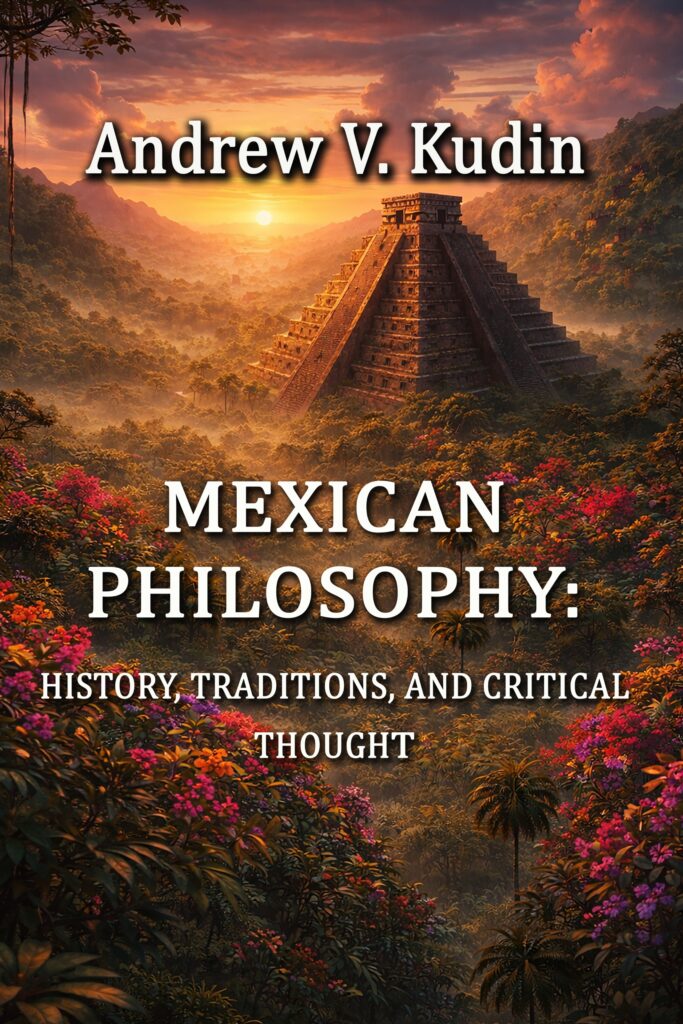
Book
Mexican Philosophy: History, Traditions, and Critical Thought
- Hardcover
- ISBN 978-1-971325-04-0
- Paperback
- ISBN 978-1-971325-03-3
- Kindle
- ISBN 978-1-971325-05-7
- EPUB
- ISBN 978-1-971325-06-4
- LCCN
- 2026901561
Overview
About the Book
Mexican philosophy did not begin with conquest. Long before 1521, Nahua and Maya thinkers were already asking what reality is, how truth can be lived, what steadies a human life in an unstable world, and how time orders existence.
Then came rupture.
Conquest did not create philosophical thought in Mexico; it altered its conditions. Indigenous worlds met colonial power, Christian theology, European law, and institutions that claimed authority over knowledge itself. Philosophy now had to work inside conflict.
Mexican Philosophy: History, Traditions, and Critical Thought treats Mexican philosophy as a tradition with its own conceptual weight. Its ideas are never safely detached from history. They enter law, education, religion, political institutions, and struggles over identity. A concept can legitimate conquest or expose it. It can organize a state, challenge a canon, or give form to resistance.
The book unfolds through six modules.
MODULE I. Philosophy, History, and the Question of Mexico opens with the struggle over philosophical legitimacy: canon, exclusion, geography, identity, translation, and the problem of beginnings.
MODULE II. Indigenous Traditions and Philosophical Worlds examines Nahua ontology, ethics, truth, and poetic knowledge before turning to Maya thought on time, creation, mathematics, and moral order.
MODULE III. Conquest, Law, and the Redefinition of the Human places conquest before the tribunal of law, from the Valladolid Debate and natural law to colonial Scholasticism and Sor Juana Inés de la Cruz.
MODULE IV. Modernity, the State, and Philosophical Transformation follows the remaking of political reason through Enlightenment, independence, liberalism, constitutionalism, Positivism, science, and education.
MODULE V. Crisis, Culture, and Philosophical Self-Interpretation turns inward: anti-Positivism, lo mexicano, Octavio Paz on solitude, alienation, memory, and the search for a language adequate to modern Mexican identity.
MODULE VI. Critical Thought and Philosophy after Colonialism moves into the Philosophy of Liberation, dependency, alterity, peripheral reason, border thinking, and mestiza consciousness.
Primary sources are integrated throughout, with argument analysis, structured questions, scaffolded assignments, chapter reviews, and further reading designed for direct use. This single-volume Mexican philosophy textbook can be read independently or used in undergraduate courses in Latin American Philosophy, Introduction to Philosophy, Ethics, Political Philosophy, World Religions, and Chicano and Latin American Studies.
The harder question is what philosophy becomes when Mexican thought begins to set the terms of the argument.

Sample
Read an Excerpt
Watch
Book Trailer

Purchase
Where to Buy
Research