Kabbalah begins with an act of reception. The Hebrew word points to something handed down, and that meaning reveals more than the modern association of Kabbalah with secrecy, symbols, or occult knowledge. Classical kabbalistic teaching belonged to a chain. A student learned from a teacher who stood within an earlier transmission, often after years of preparation and with no assurance that the teaching would be given at all.
Kabbalah is harder to define than the familiar phrase “Jewish mysticism” suggests. Jewish mystical and esoteric traditions existed long before the medieval appearance of Kabbalah. Visions of the divine throne and heavenly ascent, speculation about creation, sacred names, and the power of Hebrew letters all belong to its prehistory. Medieval kabbalists took over parts of this world and reorganized them around new accounts of divine manifestation, Scripture, prayer, commandment, and human action.
Ezekiel was no kabbalist, and the doctrine of the sefirot was unknown to the authors of the early Hekhalot texts. Reading every earlier Jewish esoteric text as Kabbalah makes the tradition appear older, more unified, and more continuous than the evidence allows.
Medieval Kabbalah bound hidden knowledge to action. Knowledge of the divine world altered the meaning of prayer, interpretation, commandment, and intention. What a person understood about invisible reality changed what his visible acts were thought to accomplish.
Contents
Before Kabbalah: Earlier Jewish Esoteric Traditions
The Emergence of Kabbalah in Medieval Europe
Two Medieval Paths of Kabbalah
Speaking About the Unspeakable
Sabbatai Zvi and the Crisis of Messianic Kabbalah
Hasidism and the Transformation of Kabbalah
What Makes Kabbalah Distinctive?
What Is Kabbalah?
The Meaning of Kabbalah
The Hebrew root q-b-l means “to receive.” Kabbalah names received tradition first, and a body of mystical doctrine only second.
Authority follows the line of transmission. A lone discoverer announcing a truth to the public has no place in this picture. The teaching passes between people, carrying claims about language, earlier study, and religious practice, and it depends on the judgment of a teacher who decides whether a student is ready to receive more.
Secrecy alone does not explain this structure. A secret can be hidden for any number of reasons. Esoteric teaching makes a claim about fitness: knowledge appropriate for one person may mislead or endanger another. Classical sources therefore surround certain subjects with restrictions that sit uneasily beside the modern assumption that every form of knowledge should be immediately available.
Those restrictions varied, and there is no reason to romanticize them. They protected hierarchy and authority as well as teaching. Yet they reveal how the material was understood. To those who kept them, kabbalistic knowledge cut loose from language, practice, preparation, and teacher was no longer the same knowledge.
Secrecy, Transmission, and Authority
The logic of restriction appears early in rabbinic literature, and in a severe form. Mishnah Ḥagigah limits the teaching of increasingly esoteric subjects according to the number and qualification of those present. The “work of creation” is restricted; the “chariot,” drawn from Ezekiel’s vision, is restricted further. It may not be expounded even to a single student unless that student can understand it on his own.
The famous story of the four who entered the pardes, the “orchard,” turns this caution into narrative. One dies and another is damaged; a third becomes the figure remembered as Aḥer, “the Other”; only Akiva enters and leaves in peace. The story tells us almost nothing about what the four encountered. Its force lies in what happened to them. Long before medieval Kabbalah emerged as a recognizable movement, Jewish sources were already asking who should approach esoteric knowledge and under what conditions.
The concern passed to later kabbalists. Teachers guarded oral traditions, protested when students disclosed them publicly, and distinguished between what could be written, what could be hinted, and what should pass directly from teacher to disciple. Yet secrecy repeatedly gave way. Material preserved in small circles entered commentaries; commentaries became books; books traveled beyond the control of those who wrote them. The history of Kabbalah is also a history of the gradual failure of secrecy.
Kabbalah Within Jewish Tradition
Kabbalah developed inside Jewish textual and religious life. Torah, rabbinic interpretation, prayer, commandments, and halakhah (Jewish law and legal practice) supplied the setting in which its central doctrines made sense.
Remove that setting and the concepts begin to change. The sefirot can become a diagram of personality, Hebrew letters a symbolic technology, and tikkun a general term for self-improvement. Historically, these ideas belonged to arguments about God, creation, Scripture, worship, exile, commandment, and the obligations of Jewish religious life.
Nor did Kabbalah form a single philosophical system. Its texts disagree, its schools developed different aims, and many of its most influential works proceed through myth, symbol, commentary, ritual intention, or visionary practice. Formal demonstration is not their way. Still, kabbalists entered again and again into questions that philosophy claimed as its own: divine unity and infinity, creation and language, evil and freedom, and the relation between a transcendent God and a finite world. No wonder the boundary between philosophy and Kabbalah stayed contested: the two traditions worked on some of the same problems by very different means.
Before Kabbalah: Earlier Jewish Esoteric Traditions
Ezekiel’s Chariot
The biblical source that casts the longest shadow over early Jewish mysticism is Ezekiel’s vision by the Chebar Canal.
The prophet sees living creatures, wheels, fire, a firmament, and above it a throne. Even at the climax, Ezekiel speaks of an appearance of a likeness of divine glory. His language retreats, phrase by phrase, from any claim to describe directly. Rabbinic tradition later treated the merkavah, the divine chariot, as a subject requiring exceptional caution.
The chapter offers no systematic map of the divine realm. Its images generated centuries of interpretation without explaining how they fit together, and later speculation grew in that gap between vision and doctrine. Readers asked what such a vision disclosed, who was entitled to seek knowledge of the heavenly world, and whether ascent toward it belonged to interpretation, religious experience, ritual technique, or some combination of these.
Merkavah and Hekhalot Literature
The Hekhalot literature elaborates what Ezekiel had approached with such reticence. Hekhal means “palace,” and the texts describe movement through successive heavenly palaces toward the divine throne. The traveler encounters angelic guardians, gates, seals, divine names, hymns, and dangerous tests. Preparation may involve fasting, ritual purity, bodily postures, and repeated recitation.
Modern categories fit the material badly. Visionary ascent appears beside procedures for gaining extraordinary knowledge. Some texts describe the adjuration of an angelic “Prince of the Torah” who grants memory and mastery of sacred learning. Mystical experience, ritual technique, and the desire for knowledge occupy the same manuscripts.
Even the direction of the journey is a puzzle. The practitioners are called yordei merkavah, those who “descend” to the chariot, although the narratives describe a journey upward. Explanations have been proposed; none has settled the matter.
Dating is no easier. The material circulated in changing forms, and surviving manuscripts vary enough that treating the Hekhalot literature as a set of fixed works with secure dates distorts the evidence. Some scholars place important layers in late antiquity; others assign substantial portions to later periods. The Hekhalot texts belong to the prehistory from which Kabbalah eventually emerged, but they supply no straight line of descent to the medieval tradition.
Sefer Yetzirah: Creation Through Letters and Numbers
Sefer Yetzirah, the Book of Formation, is brief, anonymous, transmitted in several recensions, and notoriously difficult to date. Its language and literary form resist secure classification.
The text opens with thirty-two “wondrous paths of wisdom”: ten sefirot belimah and the twenty-two letters of the Hebrew alphabet. The shared word sefirot invites comparison with medieval Kabbalah, and the comparison fails. These ten are not Keter, Ḥokhmah, Binah, Tiferet, Malkhut, and the remaining divine configurations of the later tradition. No Tree of the Sefirot appears here. A familiar term is present before the familiar doctrine exists.
The twenty-two letters occupy even more of the work. They are engraved, hewn, weighed, combined, and permuted; through them the created order takes shape. Language belongs to cosmology itself: the Hebrew letters take part in the making of the world.
Later Jewish esoteric traditions would develop elaborate practices involving letter combinations, divine names, numerical relations, and symbolic interpretation. Sefer Yetzirah is stranger than many of those later readings allow. Its cosmology has none of the theological architecture that medieval Kabbalah would build.
The elements were all in place, from throne visions and perilous ascent to sacred names, guarded transmission, speculation about creation, and letters that helped shape the cosmos. Beginning in Provence and Gerona in the twelfth and thirteenth centuries, these materials entered a new configuration.
The Emergence of Kabbalah in Medieval Europe
Sefer ha-Bahir
By the late twelfth century, Sefer ha-Bahir, the Book of Brightness, had entered the historical record. Its precise provenance remains disputed, though its early circulation is tied to the Jewish communities of southern France. The work has no continuous argument. Questions appear without preparation, answers give way to parables, letters become objects of interpretation, and one subject disappears into another without warning. Kings, daughters, gardens, springs, trees, and hidden treasures carry meanings the text rarely explains.
With the sefirot, the Bahir breaks decisively from Sefer Yetzirah. The older work had placed its ten sefirot belimah within an account of creation. In the Bahir the term begins to name powers within the divine order itself, distinct enough to enter into relation yet still belonging to the one God. They appear through a fluid vocabulary of light, wisdom, crown, root, heart, daughter, and treasure. The ordered diagrams of later Kabbalah do not yet exist.
The new symbolic language goes further. One of the divine powers is represented as feminine; relations within the Godhead include separation and union; human action reaches into the divine world, and a commandment enters a structure larger than the person who performs it.
Maimonides was completing the Guide for the Perplexed within roughly the same generation. Philosophical and kabbalistic responses to the limits of religious language were taking shape at the same time.
Provence and Gerona
Isaac the Blind (c. 1160–1235), son of Abraham ben David of Posquières, stands near the beginning of the identifiable medieval kabbalistic tradition. He is among the earliest named figures whom the surviving evidence connects with systematic teaching about the sefirot, and his disciples carried those teachings from Provence into Catalonia.
Writing threatened the discipline of restricted transmission from the start. Isaac complained in a letter to the sages of Gerona that esoteric teachings were being spoken openly, committed to writing, and circulated among people he considered unprepared. The problem was built into the medium. What passed from teacher to student could be withheld; what entered a manuscript could travel.
Ezra ben Solomon (d. 1238 or 1245), Azriel of Gerona (c. 1160–1238), and others in the circle kept writing. Their commentaries brought conceptual order to teachings that had circulated more narrowly and opened them to further interpretation. Within a few generations, an esoteric tradition possessed a literature.
This was also the world in which the writings of Maimonides were provoking bans, counter-bans, and fierce arguments over philosophy. The same communities could hold philosophical controversy, talmudic scholarship, biblical interpretation, and emerging Kabbalah. Medieval Jewish thought knew nothing of the disciplinary boundaries later scholarship would impose on it.
Naḥmanides: Law, Exegesis, and Esoteric Tradition
In Moshe ben Naḥman, Naḥmanides (1194–1270), Kabbalah entered the work of one of the most authoritative rabbinic scholars of his generation: a major talmudist, biblical commentator, communal figure, and public defender of Judaism.
His commentary on the Torah marks certain passages with the phrase “by way of truth.” A few words follow, enough to point toward an esoteric reading and too little to explain it. The reader is expected either to possess the teaching already or to stop. Naḥmanides states in his introduction that such matters cannot be safely recovered by ingenuity alone; they belong to a tradition received from a teacher.
The warning produced exactly the literature it was meant to prevent: supercommentaries written to decode the hints.
Naḥmanides never needed to detach Kabbalah from the rest of his work in order to make room for it. Talmudic law, biblical exegesis, communal authority, and esoteric teaching belonged to one body of work. With his standing behind it, Kabbalah won what secrecy alone could never supply: public rabbinic authority without public exposition.
Two Medieval Paths of Kabbalah
By the later thirteenth century, medieval Kabbalah had already divided into markedly different forms.
Theosophical-Theurgical Kabbalah
One current concentrated on the structure and relations of the sefirot. For this current, Scripture disclosed the dynamics of the divine order, and prayer and commandment took part in them.
Theurgy names the claim that a properly performed religious act affects relations within the divine realm. Obedience, character, and communal order no longer exhaust what a commandment does: what occurs below bears upon what occurs above. This conception would become central to the Zohar, and it changed the meaning of religious action at its root.
Abraham Abulafia and Ecstatic Kabbalah
Abraham Abulafia (1240–after 1291) developed a very different practice. He studied philosophy deeply and returned again and again to Maimonides, whose Guide he regarded as indispensable. His own method worked on Hebrew letters and divine names through controlled breathing, vocalization, head movements, and systematic permutation. He called it the “science of combination.”
The practitioner writes combinations of letters, varies their vowels, pronounces them with regulated breath, and coordinates sound with bodily movement. Ordinary language is deliberately dismantled. Words cease to arrive as familiar units of meaning; the alphabet is broken apart and recombined until habitual patterns of thought begin to loosen.
Abulafia describes the resulting experience in unusually personal language. Bonds are untied, seals broken, and the practitioner may encounter his own form standing before him and speaking. He interpreted such states as prophecy and the transformation of the intellect.
Abulafia’s debt to philosophy shows why the opposition “mysticism versus rationalism” fails here. He carried a Maimonidean account of intellect and prophecy into a disciplined practice meant to produce that very experience.
He was sharply critical of theosophical Kabbalah. The attempt to describe ten powers within God came, in his eyes, dangerously close to compromising divine unity. His own work turned attention to the human intellect and away from elaborate maps of the Godhead.
The messianic expectations that accompanied his claims to prophecy made him controversial. Solomon ibn Adret of Barcelona attacked him fiercely, and Abulafia’s writings remained outside the principal Spanish theosophical current. They survived nonetheless and later entered meditative traditions by indirect routes.
One current mapped relations within the divine world; another sought transformation through language itself. Castile would soon produce a body of writing vast enough to overshadow both.
The Zohar
What Is the Zohar?
The Zohar emerged from Castile in the late thirteenth century. Calling it a book suggests a unity it does not have.
The principal narratives present Rabbi Shimon bar Yoḥai and his companions traveling through the Galilee. They walk, meet strangers, rest beneath trees, interpret verses, weep, embrace, and resume the journey. A donkey driver turns out to know more than the scholars at his side. A verse opens into a discourse on the hidden structure of reality, and the conversation ends where another encounter begins. The road belongs to the teaching.
The language feeds the illusion of antiquity. The Zohar is written largely in a literary Aramaic fashioned from older forms, nobody’s everyday speech. Its voice sounds ancient because it was made to sound ancient.
The corpus itself contains different strata, styles, and subjects. The central homiletical material stands beside writings on the soul, death, the world to come, and highly compressed accounts of divine configurations. Other sections stage great assemblies in which concealed teachings are disclosed with an intensity closer to visionary drama than to philosophical exposition.
What the Zohar builds is a textual world, and its form is part of its theology.
Moses de León and the Question of Authorship
Within the work, the teachings belong to Shimon bar Yoḥai, a second-century sage. Historically, zoharic writings begin to appear and to be cited in Castile during the closing decades of the thirteenth century. Their circulation is closely associated with Moses de León (c. 1240–1305).
Modern scholarship has made the picture more complicated than a choice between ancient authorship and a single medieval author. The corpus contains different voices and layers, raising questions about composition, editing, earlier materials, circles of writers, and the role de León himself played in the process.
Whatever the precise history of composition, the feat is plain. Teachings produced in medieval Castile entered a narrative world populated by the sages of Roman Palestine, and the authority of antiquity was built into the very form in which readers met the doctrines.
That authority grew slowly. During the fourteenth century the Zohar remained one esoteric corpus among several. After the expulsions from Iberia, it traveled with Jewish communities into North Africa, Italy, and the Ottoman lands. Complete printed editions appeared at Mantua and Cremona in the late 1550s, despite objections from rabbis who regarded the printing press as an unsuitable instrument for a literature of secrets.
The objection contained its own prediction. Print permanently changed the scale on which esoteric transmission could be controlled.
Scripture as a Mystical Text
The Zohar compares Torah to a body clothed in garments. A reader who sees only the narrative surface has mistaken the clothing for the person. Beneath that surface lie deeper orders of meaning, yet the surface itself remains indispensable. One enters through the verse.
A biblical episode can disclose relations among the sefirot. A word, an apparent redundancy, a grammatical feature, or an unexpected image can become an opening into the structure of reality. Exegesis becomes a religious act because Scripture is treated as a site where the visible wording and the hidden order continually meet.
Such reading weighs textual detail heavily. If Scripture corresponds to relations within the divine order, even minor features cannot be written off as accidents.
The interpretive freedom was immense, but it was never imagined as entirely private. Kabbalistic reading remained tied to inherited texts, teachers, communities, and traditions of transmission. Symbolic interpretation could expand almost without limit; authority was expected to supply the limits that interpretation itself could not.
Shekhinah, Exile, and Divine Relation
Rabbinic literature had spoken of the Shekhinah, the divine presence, as present in worship, study, judgment, suffering, and Israel’s exile. Zoharic Kabbalah gives her a new place. She becomes closely identified with Malkhut, the lowest sefirah, feminine in much of the symbolism and turned toward the created world as the receiver of what descends from above.
Malkhut relates to Tiferet as bride to bridegroom, feminine to masculine, in a rhythm of separation and union. Their union permits abundance to flow; their separation appears as exile. Sexual imagery carries the structure of transmission itself: giving and receiving, generative power, interruption, reunion.
Human action enters directly into this drama. A commandment performed with proper intention strengthens union above. Transgression intensifies separation and nourishes what the Zohar calls the “other side.” Exile, then, belongs to the divine order as well as to political history.
Here the distance from Maimonidean theology becomes stark. Maimonides defended divine unity by denying that relations, distinctions, or positive attributes belong to the divine essence. Zoharic Kabbalah speaks of masculine and feminine, giving and receiving, union and separation, abundance and obstruction, and still insists that God is one.
The difficulty is now unavoidable. If ultimate divinity is infinite and indivisible, what are the ten sefirot? Should they belong to God, multiplicity has entered divine unity. Should they not, how can acts performed through them reach God at all?
The vocabulary of Kabbalah had become rich enough to describe the divine world. It now had to explain what that description meant.
Ein Sof and the Sefirot
Ein Sof: The Infinite Beyond Definition
Kabbalah required a name for what lies beyond every divine name, and the name it produced refuses ordinary naming.
Ein Sof means “without end” or “without limit.” The term appears in the Gerona circle in the thirteenth century; the Bahir does not use it.
No verse of the Torah calls God Ein Sof. The commandments are not addressed to it, and prayer does not turn toward it directly. Scriptural names, attributes, commands, and promises belong to the level at which divinity becomes manifest through the sefirot. Ultimate divinity remains beyond the distinctions that make address and relation possible.
Ein Sof is no separate being stationed somewhere above the God of Scripture. The distinction runs within the divine, between what lies beyond determination and what is manifest, named, addressed, and active. Once a name is spoken, a distinction has entered.
Even the word “infinite” can mislead if it suggests an immeasurably large quantity. The kabbalistic claim is more radical. What has no limit cannot be contained by concept, image, location, or name. Yet the tradition that insists on this unknowability also develops an elaborate account of the forms through which hidden divinity becomes accessible.
The Ten Sefirot
The sefirot belong to that account. They have been described as emanations, powers, attributes, or modes of divine manifestation, although no single term covers every kabbalistic use. Schools differed over their ontological status. In every version, the sefirot mediate between the hidden source and the differentiated world.
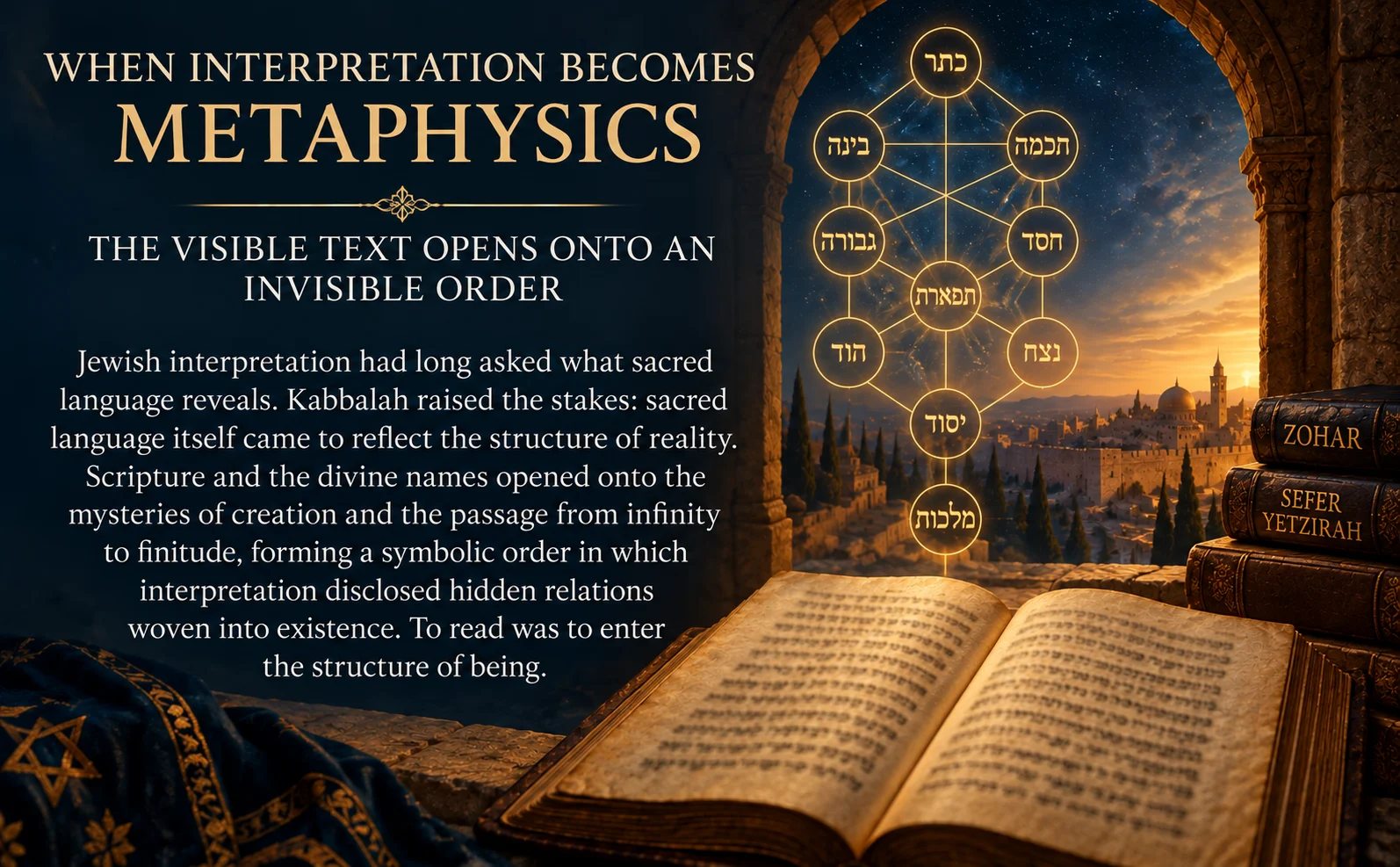
The standard order is Keter, Ḥokhmah, Binah, Ḥesed, Gevurah, Tiferet, Netzaḥ, Hod, Yesod, and Malkhut. A bare list, however, says little about how they function. The ten exist through their relations.
Keter, the crown, stands nearest the hidden source and is often associated with will. Ḥokhmah, wisdom, appears as a concentrated point of possibility; Binah, understanding, unfolds what is contained there. The lower sefirot develop patterns of expansion and restraint, giving and judgment, balance, transmission, and reception. Intellectual, bodily, sexual, spatial, biblical, and liturgical languages overlap within the same system.
The familiar image of the Tree arranges them along right, left, and central columns. The right is associated broadly with expansion, the left with restriction, and the center holds the two together. Unlimited giving would dissolve boundaries; pure restriction would leave no room for anything to flourish.
The Tree grows downward. Its root is above, and what descends through it is called shefa: influx, overflow, abundance. Each level receives the flow and passes it on, until Malkhut faces the created worlds.
The same pattern can be mapped onto a body. Wisdom may correspond to the brain, understanding to the heart, other sefirot to arms, torso, legs, generative organs, and mouth. A text can draw that body in detail and then deny that God possesses any likeness whatsoever.
Unity and Multiplicity
What, then, are the sefirot in relation to God? Each answer had its cost. Fully divine sefirot seem to bring plurality into God; sefirot standing outside God risk becoming created intermediaries. Abraham Abulafia had already attacked theosophical Kabbalah on this ground, and philosophical theology sharpened the objection: a simple divine essence cannot contain internal composition.
Some kabbalists treated the sefirot as aspects of the divine essence itself. The language of divine life then retains its full force, but plurality remains inside the Godhead. Others described the sefirot as kelim, vessels or instruments through which the essence acts; this protects divine simplicity more easily and leaves the vessels themselves harder to explain.
The Safed kabbalist Moses Cordovero (1522–1570) later tried to hold the two claims together. Divine essence is present in the sefirot without being identical with any one of them. His image is water poured into colored vessels: the water appears red or green according to the glass through which it is seen while remaining unchanged in itself.
The image solves only part of the problem. Put mercy and judgment entirely in the vessels, and the distinctions of divine life are no longer differences in the source itself. Put them in the source, and simplicity is compromised.
The dispute never closed. Kabbalistic theology went on affirming both divine unity and the reality of differentiated manifestation.
Theurgy: When Human Action Reaches the Divine
Shefa flows down through the sefirot toward the created world, and the current runs both ways. Prayer, commandment, study, blessing, and intention are understood to rise along the same paths and awaken a response. The sources often call this rising an “arousal from below.”
Cordovero describes human deeds as ascending through spiritual channels to their root. The response returns as abundance to the lower world. Proper action opens a passage; disordered action obstructs one. Before Lurianic Kabbalah enlarged the cosmological meaning of tikkun, the term could refer to the restoration of proper relation among the sefirot: joining what had been separated, tempering judgment with mercy, reopening the way for vitality to flow.
A blessing over bread can therefore carry consequences beyond the awareness of the person who recites it. Intention determines whether the act participates fully in a larger pattern of giving and response.
For philosophical theology, the difficulty is immediate. If human conduct changes relations within divinity, then what occurs outside God seems capable of affecting what occurs within God. Dependence and mutability, precisely what classical theology sought to exclude from the divine essence, reappear inside the religious act.
Kabbalistic theurgy accepts that tension because relation is indispensable to its account of prayer and commandment. Worship here takes part in the divine life it addresses: human action joins the circulation of giving, restriction, union, and abundance that the sefirot describe.
Speaking About the Unspeakable
Maimonides and the Limits of Divine Language
Maimonides had stated the problem of divine language with exceptional severity. If God is absolutely one and unlike created beings, positive predicates cannot describe the divine essence in the ordinary way. Calling God wise, powerful, or living risks applying creaturely categories to a reality outside the order to which those categories belong. Negative theology protects transcendence by refusing to make God one object among others.
Kabbalah shared that resistance to finite description, and Ein Sof intensified it: no thought grasps the infinite, and no divine name contains it. From that common limit the two traditions part ways. Maimonidean theology restricts assertions about the divine essence. Kabbalah develops a symbolic vocabulary for the ways hidden divinity shows itself. The sefirot allow speech to continue without claiming that such speech has captured God as He is in Himself. Kabbalah’s language of infinity arose in a world already schooled by negative theology.
Apophasis and Symbol
Elliot R. Wolfson puts the problem well in Apophasis and Envisioning the Invisible. In the introduction he calls the apophatic a gesture of “speaking-not” (p. 1): an attempt to say the unsayable that refuses to retreat into complete silence.
Kabbalistic texts speak abundantly about what they also declare impossible to grasp. Ein Sof is approached through light, nothingness, source, crown, tree, body, king, bride, river, and sea. None of these images is sufficient. Each discloses something only so long as it is not mistaken for an exhaustive description.
Here apophasis and abundant speech go together. Symbols can multiply precisely because no single symbol claims final possession of its object; every assertion carries its own withdrawal.
A body can therefore map the sefirot without turning God into a body. The image discloses sequence, relation, direction, or transmission without becoming a claim about divine anatomy.
Complete silence would protect transcendence at the cost of leaving nothing with which to interpret Scripture, organize prayer, or speak about the relation between the hidden divine and creation. Kabbalah instead developed a language whose adequacy remained permanently limited by what it sought to name.
Why Kabbalah Uses Symbols
Kabbalistic symbols carry relations that abstract definitions tend to separate.
The bride and bridegroom hold together gender, union, separation, desire, transmission, and the relation between Tiferet and Malkhut. In the Tree, direction, hierarchy, balance, circulation, and dependence share a single image. Light suggests disclosure and flow without turning either into a physical mechanism.
Malkhut can be kingdom, moon, sea, mouth, bride, Shekhinah, and the receiving edge of the sefirotic order. No one image defines it; their intersections create its field of meaning.
Symbol also keeps Scripture active within theology. A biblical person, bodily organ, direction, color, number, or narrative episode can enter the kabbalistic system without hardening into a fixed allegorical code, so interpretation never runs out.
Ambiguity follows from this density. Symbols accumulate meanings, intersect with other symbols, and resist the clean boundaries expected from philosophical definition. For the kabbalists, that instability was inseparable from the subject itself. A reality understood to exceed conceptual determination could not be rendered adequately through concepts alone.
Kabbalistic symbolism shapes what remains hidden and never lets the shape become final. In Safed, that vocabulary of vessels, channels, concealment, and transmission would be reorganized around a far more disturbing possibility: that the divine order itself had undergone rupture.
From Spain to Safed
The expulsion of Jews from Castile and Aragon in 1492 redrew the map of Jewish intellectual life. Refugees and their descendants established new centers across North Africa, Italy, and the Ottoman Empire. By the sixteenth century, Safed, a small town in the Upper Galilee, had become one of the most remarkable of them.
Ottoman rule after 1517 offered a comparatively stable setting, and the local wool and textile trade supported a growing community. Nearby Meron was revered as the burial place of Shimon bar Yoḥai, the sage whose voice dominates the Zohar. The scholars who gathered in Safed visited the graves of earlier sages, prayed there, and made sacred geography part of their mystical practice.
In the same town, legal scholarship, poetry, and Kabbalah flourished side by side. Joseph Karo was completing the work that would culminate in the Shulḥan Arukh; Shlomo Alkabetz wrote the Sabbath hymn Lekha Dodi; Moses Cordovero was organizing centuries of kabbalistic speculation into a systematic theology. Near the end of Cordovero’s life Isaac Luria arrived, and in a very short time he introduced a cosmology that transformed the language of Kabbalah.
Gershom Scholem (1897–1982) later interpreted Lurianic Kabbalah through the historical experience of exile, seeing in its cosmology of rupture and restoration a religious response to the catastrophe of 1492. The reading helps explain why the doctrine later resonated so widely, but it cannot bear the weight of a simple causal line. Luria’s circle rarely wrote directly about the Spanish expulsion, and two generations separated the event from his teaching. Print, migration, Safed’s growing prestige, and the work of Luria’s disciples also shaped how far and how fast the system spread.
Moses Cordovero
Moses Cordovero received three centuries of kabbalistic writing that had never settled into a single system. The Zohar itself contains tensions; Provençal and Geronese writers used common terms differently; symbols overlapped, and separate schemes of correspondence did not always agree.
Cordovero completed Pardes Rimmonim, the Orchard of Pomegranates, in 1548, at the age of twenty-six. He arranged the material by subject, compared competing positions, and imposed conceptual order on a literature that had grown mostly through commentary and symbol.
The problem that occupied him had shadowed the doctrine of the sefirot from its beginnings: how differentiated divine powers could coexist with absolute unity. Pardes Rimmonim left the tension in place and set the competing claims out in a systematic form in which they could be taught, compared, and argued.
Tomer Devorah draws the ethical consequence. If the human being bears the divine image, conduct should reflect the qualities displayed through the sefirot. Patience, generosity, restraint, mercy, and the disciplined use of anger become ways of imitating God. A cosmology of divine attributes turns into a discipline of character.
Cordovero died in 1570. Isaac Luria had recently arrived in Safed.
Isaac Luria and Ḥayyim Vital
Isaac Luria was born in Jerusalem in 1534 and raised in Egypt after his father’s death. His early formation was rabbinic and legal. Later accounts describe years of seclusion devoted to the study of the Zohar, although much of the surviving biographical material comes through disciples and carries the marks of hagiography.
He settled in Safed around 1569 or 1570 and died in an epidemic in 1572, at thirty-eight; his teaching there lasted barely more than two years. Most of the system that bears his name survives through disciples who recorded and organized what they remembered him teaching.
Ḥayyim Vital (1542–1620) became the principal architect of that transmission. A former student of Cordovero, he attached himself to Luria and later devoted decades to arranging the teachings into extensive accounts of cosmology, prayer, intention, souls, and transmigration. Other disciples preserved different versions, and later kabbalists continued to interpret and reorganize the material.
“Lurianic Kabbalah” therefore names a tradition transmitted through several stages: oral teaching, recollection, compilation, competing recensions, and subsequent commentary. Its immense influence grew from a master who left almost no systematic exposition in his own hand.
The Lurianic Cosmos
Tzimtzum
Lurianic cosmology begins from a radical problem. If Ein Sof fills all reality without limit, where can a finite world exist?
The first movement is tzimtzum: contraction, withdrawal, or concealment. In the Lurianic account, divine light withdraws from a central region, leaving a vacated space within which differentiation becomes possible. A trace remains, and a thin line of light enters the space to begin the formation of worlds.
Later kabbalists argued over how literally to understand this withdrawal. Some resisted any suggestion that God had actually become absent from a place, interpreting tzimtzum instead as concealment from the perspective of created beings. The spatial imagery carries a metaphysical problem: how can finitude arise within a reality beyond limit without becoming a second reality independent of God?
Creation begins with self-limitation: difference needs a space in which to appear.
Shevirat ha-Kelim: The Breaking of the Vessels
The light entering the differentiated order must be received. Vessels are formed for that purpose, but the early configuration cannot contain the intensity passing through it. They shatter.
In shevirat ha-kelim, the breaking of the vessels, fragments fall into lower regions carrying sparks of divine light with them. The fallen fragments become associated with the kelipot, the “husks” or shells that conceal holiness and draw vitality from what they imprison.
History thus begins inside a reality whose disorder is older than humanity. The world is already an aftermath.
What kind of catastrophe this is, the sources leave unsettled. Their language is the language of failure. Yet later interpretations place the rupture within a larger divine process in which a world capable of freedom and repair emerges only through incompleteness. Accident and purpose remain uneasily joined.
Divine Sparks, Exile, and Tikkun
The scattered sparks make creation a world of mixture. Holiness survives within conditions that conceal it, and tikkun (repair, restoration, or rectification) consists in separating, elevating, and returning what has fallen.
Exile appears on several levels at once. Israel experiences exile historically; the Shekhinah is described through separation; souls can be displaced from their proper roots; sparks of holiness are dispersed throughout the material world. Lurianic teaching gathers these different forms of displacement into a cosmology of separation and return.
The work of repair is done through commandments performed with the proper intention. Eating, blessing, prayer, Sabbath observance, and other acts of religious life become occasions for birur, the separation and elevation of sparks. Material existence becomes the very field of repair; the mystic has no need to escape it.
The Lurianic meaning of tikkun should be kept distinct from two other uses of the word. In the Mishnah, mipnei tikkun ha-olam refers to legal measures adopted so that social and juridical life can continue to function. Modern Jewish usage often employs tikkun olam for social responsibility and justice. Lurianic tikkun concerns the restoration of a cosmic order damaged before ordinary human history begins.
Human Responsibility in a Broken Cosmos
Human beings enter the Lurianic story after the rupture, but their arrival changes what happens next. The primordial catastrophe is not theirs to have prevented; repair nevertheless depends upon their acts.
Luria associated individual souls with particular roots and particular work. The religious life thus takes on a personal dimension inside the larger cosmology. Different people encounter different portions of an unfinished order, and the commandments through which they live become means of participating in its restoration.
A person who knows none of this still performs the commandment within Jewish law. The kabbalist believes he also understands something of its invisible consequence. A blessing can release what is trapped, prayer join what has been separated, intention direct an act toward a particular repair. Knowledge widens the field of responsibility: an act once felt as local now enters a much larger order.
The claim is demanding, yet it asks for no heroics. Most of the work happens in the daily round of prayer, blessing, and commandment, and ordinary acts carry the whole extraordinary cosmology.
Kabbalistic Practice
Kavvanah: The Discipline of Intention
Kavvanah had long meant attention or intention in prayer: understanding the words, knowing before whom one stands, and refusing to let recitation proceed while the mind is elsewhere.
In Lurianic practice the kavvanot, in the plural, became highly technical. The worshipper attends to processes the spoken prayer does not name. Particular blessings correspond to levels within the worlds; phrases bear upon specific divine configurations; spellings, vocalizations, and numerical forms of divine names are contemplated at precise moments.
The lips follow the fixed liturgy while the mind holds another layer of activity. A familiar prayer can contain an elaborate sequence of contemplative operations invisible to anyone hearing it.
Vital’s Shaʿar ha-Kavvanot presupposes extensive knowledge of the system. Such practice demanded memory, concentration, and technical mastery far beyond common devotional attention, and the literature never suggests that every worshipper was expected to perform it.
Prayer and Commandment
Lurianic Kabbalah left the established forms of Jewish worship intact. The liturgy, the wording of the blessings, and the legal forms of Sabbath and commandment stayed as they were. The new complexity lay in what trained practitioners believed those acts accomplished.
Here much Lurianic practice parts company with traditions centered on heightened states of consciousness. Abraham Abulafia had deliberately cultivated prophetic and ecstatic experience; Lurianic practice more often places mystical work inside prescribed religious action itself.
The commandment matters because it is commanded, but for the kabbalist it also becomes a point at which earthly action enters a network of divine relations.
Yiḥudim
A yiḥud is a unification: a prescribed contemplative act that joins specified divine names or configurations for a particular work of repair. Unlike the fixed daily prayers, yiḥudim could be performed separately and directed toward specific purposes. Vital preserved collections of them with detailed instructions.
Some were practiced at the graves of the righteous. Luria and his circle visited burial places around Safed, where contemplation could involve the soul of the deceased and its relation to the practitioner’s own spiritual task.
Vital attached demanding conditions to these exercises: repentance, discipline of appetite and anger, freedom from arrogance, and instruction from a teacher. The same texts warn that practice undertaken without adequate preparation carries danger.
Sacred Names and the Limits of Practical Kabbalah
Divine names had belonged to Jewish esoteric practice long before Safed. They appear in Hekhalot literature, in Abulafia’s combinatory methods, and again with exceptional complexity in Lurianic kavvanot.
Expanded spellings, vowel patterns, numerical values, and combinations of names correspond to different levels and relations within the system. Much of this activity remains entirely mental: the names are contemplated without being pronounced.
The modern category “practical Kabbalah” gathers together amulets, adjurations, angelic names, protective formulas, and other techniques drawn from different periods and textual traditions. They never constituted a single timeless discipline, much less the essence of Kabbalah.
The Safed sources themselves attach technique to preparation. Learning, observance, moral discipline, and the authority of a teacher determine who is entitled to undertake practices that manipulate sacred names or seek particular spiritual effects.
For the trained kabbalist, the humblest act of religious life was charged with consequences no eye could see. The world had been broken before he entered it; prayer, commandment, blessing, and intention placed part of its repair within his reach.
Sabbatai Zvi and the Crisis of Messianic Kabbalah
Sabbatai Zvi
In 1665, a messianic movement spread with astonishing speed through Jewish communities from the Ottoman Empire to Western Europe and North Africa. At its center stood Sabbatai Zvi, born in Smyrna in 1626, a kabbalist whose behavior had long disturbed every community he passed through. He pronounced the divine name, violated established fasts, performed ritual acts that appeared deliberately transgressive, and described these episodes as “strange deeds.” For years he remained a troubling figure on the margins.
Nathan of Gaza turned that reputation into a theology. He announced that a vision had revealed Sabbatai as the Messiah and interpreted his conduct through categories drawn from Lurianic Kabbalah. The fallen sparks lay trapped among the kelipot; redemption required descent into the places where holiness remained imprisoned. Sabbatai’s violations and periods of darkness could now be read as stages of that descent, undertaken by the Messiah himself.
Communities fasted, repented, prepared for the messianic age, and in some places sold property to be ready for the journey to the Land of Israel. The Ottoman authorities arrested Sabbatai. In September 1666, brought before the Sultan’s court, he converted to Islam and took the name Aziz Mehmed Effendi.
For most believers, the conversion destroyed the claim. Others accepted Nathan’s interpretation of the apostasy as the deepest stage of messianic descent. The logic that had explained transgression could now absorb conversion: the Messiah had entered the final realm of impurity because the last sparks could be recovered only there.
Lurianic Kabbalah did not produce Sabbatianism by itself. Nathan selected and radicalized particular elements within it, especially the language of exile, sparks, descent, and repair. Yet the episode exposed a danger within a religious imagination capable of assigning saving power to acts that appeared to violate the law.
After Sabbatai Zvi
Sabbatian belief survived underground in parts of the Jewish world long after Sabbatai’s conversion and death. Accusations of concealed Sabbatianism continued into the eighteenth century. Jacob Frank later carried the logic of redemption through transgression into a still more destructive form, eventually leading his followers into Catholic baptism in Poland.
Rabbinic authorities had watched sophisticated kabbalistic arguments mobilized in support of a mass messianic upheaval ending in apostasy. In its aftermath, esoteric study was subjected in some circles to stricter controls, and claims of visions, hidden missions, and the imminent end of exile attracted a suspicion they had not carried in quite the same way before.
Kabbalah survived, but Sabbatianism changed the atmosphere in which it was received. The eighteenth century inherited both the prestige of Lurianic teaching and the memory of what had happened when its language of cosmic repair was joined to public messianic certainty.
Hasidism and the Transformation of Kabbalah
From Cosmic Drama to Religious Life
Israel ben Eliezer, the Baʿal Shem Tov (c. 1700–1760), worked in Podolia. The documentary record surrounding his life is much thinner than the later body of legend, but his association with practical Kabbalah places early Hasidism firmly inside the longer history of Jewish esotericism.
Hasidism took up Lurianic language and relocated much of its religious labor. The elaborate kavvanot of Safed demanded technical mastery available to very few practitioners. Hasidic teaching brought the elevation of sparks into eating, prayer, joy, thought, work, and the encounter with material life. Bread eaten with awareness of God could become part of the work of elevation. A distracting thought during prayer could itself contain something fallen that required transformation.
Devekut, attachment to God, moved closer to the texture of daily existence. None of this made Hasidism intellectually simple. Its schools developed complex accounts of divine immanence, selfhood, prayer, and the status of the created world. Some stressed the sanctification of material existence; others pressed toward bittul ha-yesh, the nullification of independent selfhood before God. Chabad, Bratslav, and later Polish schools took these questions in markedly different directions.
The tzaddik added a new social form to older kabbalistic ideas of mediation. The righteous leader could function as teacher, guide, intercessor, and channel of divine abundance for the community gathered around him.
Kabbalah in the Modern World
Gershom Scholem and the Academic Study of Kabbalah
Modern academic study began from a nineteenth-century Jewish historiography that had often regarded mystical literature as an embarrassment or a degeneration, peripheral to the rational achievements represented by figures such as Maimonides.
Scholem overturned that hierarchy through decades of work on manuscripts, terminology, chronology, textual transmission, and the history of mystical movements. Kabbalah, long treated as an eccentric appendage, emerged from his scholarship as a central current in Jewish religious history. Much of the field still works with questions and periods he helped define.
Scholem’s own map emphasized theosophical and theurgical Kabbalah and read its history largely through rupture: the emergence of mythic structures, the upheaval of Sabbatianism, and the place of that crisis in the passage toward modern Jewish history.
After Scholem: Moshe Idel and Elliot R. Wolfson
Moshe Idel challenged this picture from the 1980s onward. Abulafia’s ecstatic tradition, magical material, techniques of consciousness, and other forms of practice appeared in Idel’s work as substantial currents, no longer as peripheral survivals. He also emphasized continuities of transmission where Scholem’s narrative had stressed eruption and crisis.
The field became less dependent on a single history of Kabbalah. Texts could now be studied through the development of doctrines and equally through ritual, technique, experience, institutions, patterns of transmission, and the different uses to which esoteric knowledge was put.
Wolfson changed the terms of interpretation by bringing embodiment, language, eros, gender, vision, and the work performed by symbols into sustained focus. His scholarship treats these elements as constitutive of kabbalistic thought, never as ornament around a metaphysical core. Sexual symbolism, bodily imagery, grammatical form, and gendered configurations therefore become evidence in their own right: they show how kabbalistic texts construct meaning.
Popular Kabbalah and Modern Spirituality
During the twentieth century, kabbalistic language moved into settings far removed from the communities in which its classical texts had been composed. Concepts such as sefirot, tzimtzum, divine light, vessels, and tikkun entered psychology, meditation, self-improvement, universal spirituality, and commercial religious culture.
Some adaptations state openly that they are translating or combining traditions for a new audience. Their distance from medieval or Lurianic practice can then be examined without confusing adaptation with historical continuity.
Other forms retain the authority of ancient terminology while discarding much of the discipline that originally surrounded it. Commercial institutions that became internationally prominent from the 1990s drew in part on the writings of Yehuda Ashlag (1885–1954), an important twentieth-century interpreter of Lurianic Kabbalah, and presented the material in forms accessible to audiences without the linguistic and ritual background the older literature presupposed. The old vocabulary of tzimtzum, tikkun, and reception could then be recast as a language of personal transformation.
Accessibility alone does not settle the intellectual value of an adaptation. Historically, the question is whether the transformation remains visible. Sources can be traced, changes identified, and new purposes distinguished from older ones. When a modern construction presents itself as unchanged ancient transmission, the authority of the past begins to conceal the history of what has actually been altered.
What Kabbalah Is Not
Calling every Jewish esoteric tradition Kabbalah erases the historical changes that produced medieval Kabbalah. Ezekiel’s throne vision, Hekhalot ascent traditions, and Sefer Yetzirah belong to its prehistory; reading them as an earlier version of the same system flattens that history.
The picture of an unchanged esoteric system preserved intact from Moses onward fails for a similar reason. Kabbalistic texts often claimed ancient authority, but their historical record shows formation, revision, competing schools, pseudepigraphic attribution, oral transmission, manuscript variation, and continuing reinterpretation. That history explains the texts without diminishing them: it shows how they came to have the forms in which later generations received them.
Gematria, letter permutation, amulets, divine names, and practical techniques belong to parts of this history without defining the whole. A tradition broad enough to include the Bahir, the Zohar, Abulafia, Cordovero, Luria, and Hasidism cannot be reduced to one esoteric technique.
Claims that Kabbalah anticipated modern physics require a different kind of correction. Similar words do not establish identical ideas. Quantum entanglement, for example, concerns the mathematical structure of correlated quantum states and, specifically, permits no transmission of information through the entangled relation. Kabbalistic theurgy, by contrast, depends on a claim that action and abundance move through relations connecting the human and divine realms. The similarity disappears once the technical meanings are examined.
Broad assertions about a universal mystical doctrine encounter the same problem. Symbols of unity, light, nothingness, ascent, or hidden knowledge appear in many religious traditions. Resemblance establishes a basis for comparison. Historical influence requires something more demanding: contact, texts, translations, teachers, or other evidence that ideas actually traveled.
What Makes Kabbalah Distinctive?
From the Bahir onward, hidden knowledge increasingly concerned a reality in which God, Scripture, worship, and human action were bound together. In the sefirot, divine manifestation found symbolic form. The Zohar read Scripture as an entrance into those relations. Lurianic Kabbalah placed human beings inside a cosmos whose repair remained unfinished, and Hasidism carried parts of that inheritance into the movements of daily life.
The decisive feature is the position assigned to the person who knows.
Grasping the structure of the sefirot does not end the matter. If prayer strengthens a union, understanding changes how one prays. A commandment that takes part in tikkun weighs more in the hands of someone who knows it. And where intention directs an act within a larger order, every gain in insight enlarges the responsibility attached to it. The more completely a hidden relation is understood, the harder it becomes to dismiss any action as private or inconsequential.
Kabbalistic knowledge does not remove the knower from the world. It deepens the consequences of remaining within it.
Sources and Further Reading
Primary Sources
Moses Cordovero. The Palm Tree of Deborah. Translated by Louis Jacobs. Vallentine Mitchell, 1960.
James R. Davila. Hekhalot Literature in Translation: Major Texts of Merkavah Mysticism. Brill, 2013.
A. Peter Hayman. Sefer Yesira: Edition, Translation and Text-Critical Commentary. Mohr Siebeck, 2004.
Aryeh Kaplan, trans. The Bahir. Samuel Weiser, 1979.
Daniel C. Matt, Nathan Wolski, and Joel Hecker, trans. The Zohar: Pritzker Edition. 12 vols. Stanford University Press, 2004–2017.
Studies
Lawrence Fine. Physician of the Soul, Healer of the Cosmos: Isaac Luria and His Kabbalistic Fellowship. Stanford University Press, 2003.
Moshe Idel. Kabbalah: New Perspectives. Yale University Press, 1988.
Andrew V. Kudin. Jewish Philosophy and Kabbalah. Kudin & Sons Academic Press, 2026.
Gershom Scholem. Major Trends in Jewish Mysticism. Schocken Books, 1941.
Gershom Scholem. Origins of the Kabbalah. Translated by Allan Arkush. Princeton University Press, 1987.
Gershom Scholem. Sabbatai Sevi: The Mystical Messiah, 1626–1676. Translated by R. J. Zwi Werblowsky. Princeton University Press, 1973.
Isaiah Tishby. The Wisdom of the Zohar: An Anthology of Texts. Translated by David Goldstein. 3 vols. Littman Library of Jewish Civilization, 1989.
Elliot R. Wolfson. Apophasis and Envisioning the Invisible: Unveiling Veils of Infinity. Aries Book Series, vol. 42. Leiden: Brill, 2026.
Elliot R. Wolfson. Language, Eros, Being: Kabbalistic Hermeneutics and Poetic Imagination. Fordham University Press, 2005.
Elliot R. Wolfson. Through a Speculum That Shines: Vision and Imagination in Medieval Jewish Mysticism. Princeton University Press, 1994.