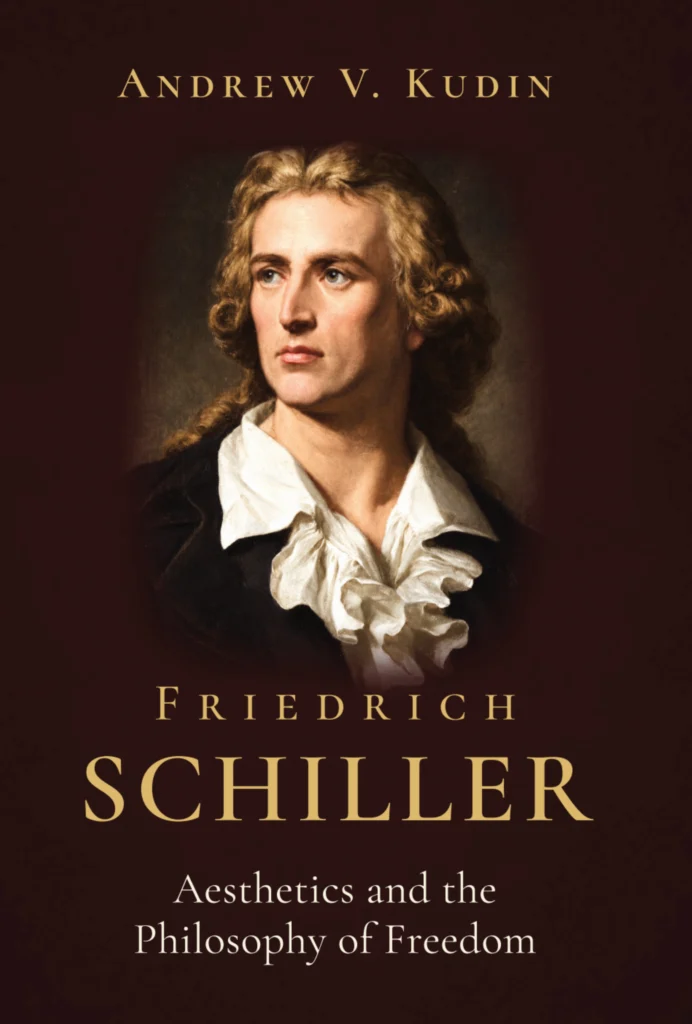
Book
Friedrich Schiller: Aesthetics and the Philosophy of Freedom
- Hardcover
- ISBN 978-1-971325-61-3
- Paperback
- ISBN 978-1-971325-62-0
- Kindle
- ISBN 978-1-971325-63-7
- EPUB
- ISBN 978-1-971325-64-4
- LCCN
- 2026927545
Overview
About the Book
How can human beings become free when reason and sensibility pull them in opposite directions? This question lies at the heart of Friedrich Schiller’s philosophy and runs through his writings on aesthetics, ethics, politics, and drama.
In Friedrich Schiller: Aesthetics and the Philosophy of Freedom, Andrew V. Kudin follows Schiller from his early intellectual formation through his engagement with Immanuel Kant’s moral philosophy and aesthetics to his mature understanding of freedom and human nature, situating his thought within the development of German philosophy.
At the core of the book stand Schiller’s theory of beauty as freedom in appearance; his reflections on grace, dignity, and the beautiful soul; the play drive; and the power of aesthetic education to transform the human being. The author examines how aesthetic experience bears on moral freedom, what Schiller’s philosophy means for politics, and how his major dramas, from The Robbers to William Tell, stage the conflicts of freedom in historical life.
Do Schiller’s philosophical essays, historical writings, correspondence, and plays add up to a coherent philosophical system? The study takes the question head-on, placing freedom at the center of Schiller’s intellectual achievement and tracing its significance for German Idealism, early Romanticism, the philosophy of art, and modern thought.
Written for scholars and students, and for any reader drawn to philosophy, intellectual history, or German literature, this monograph offers a comprehensive study of Friedrich Schiller as a philosopher of freedom, aesthetic education, and the formation of the whole human being.
Sample
Read an Excerpt
Read the opening 46 pages of Friedrich Schiller: Aesthetics and the Philosophy of Freedom by Andrew V. Kudin.This free excerpt introduces the book’s central question: Do Schiller’s writings form a coherent philosophical system? It explores the problem of freedom after Kant and traces the early intellectual development of one of Germany’s most influential philosopher-poets.The complete book comprises 288 pages.